40% of Day-One CEOs Don't Survive PE Ownership

“Just over 40% of the day-one CEOs don’t make it to the two year anniversary.”
That’s Bob Morse, Co-Founder and Managing Partner at Strattam Capital, drawing on decades of PE experience. He’s not talking about struggling companies. He’s talking about successful acquisitions where the original leadership didn’t survive the transition.
This isn’t a failure statistic. It’s a fit statistic.
If you’re a CEO or operator who just got acquired by PE, this number should change how you think about your first 18 months. You’re not proving you’re indispensable. You’re proving you can evolve.
Why the Transition Claims So Many Leaders
The skills that built a founder-led company often aren’t the skills needed to scale a PE-backed one. This isn’t a criticism. It’s math.
Reporting cadence accelerates. Monthly board meetings require a different discipline than quarterly family conversations. You need numbers ready, variance explanations prepared, forward guidance that isn’t just optimism.
Accountability sharpens. PE doesn’t fund potential indefinitely. The 100-day plan has milestones. Miss enough of them, and the conversation shifts from “how do we help?” to “do we have the right person?”
Intuition stops being enough. The founder who “just knows” which customers matter faces a board that wants to see it in the data. “Trust me” isn’t a reporting strategy.
None of this means the founder was doing it wrong. They were doing what worked for that stage. But stages change, and what got the company here won’t get it where the new ownership wants to go.
What Separates the Survivors
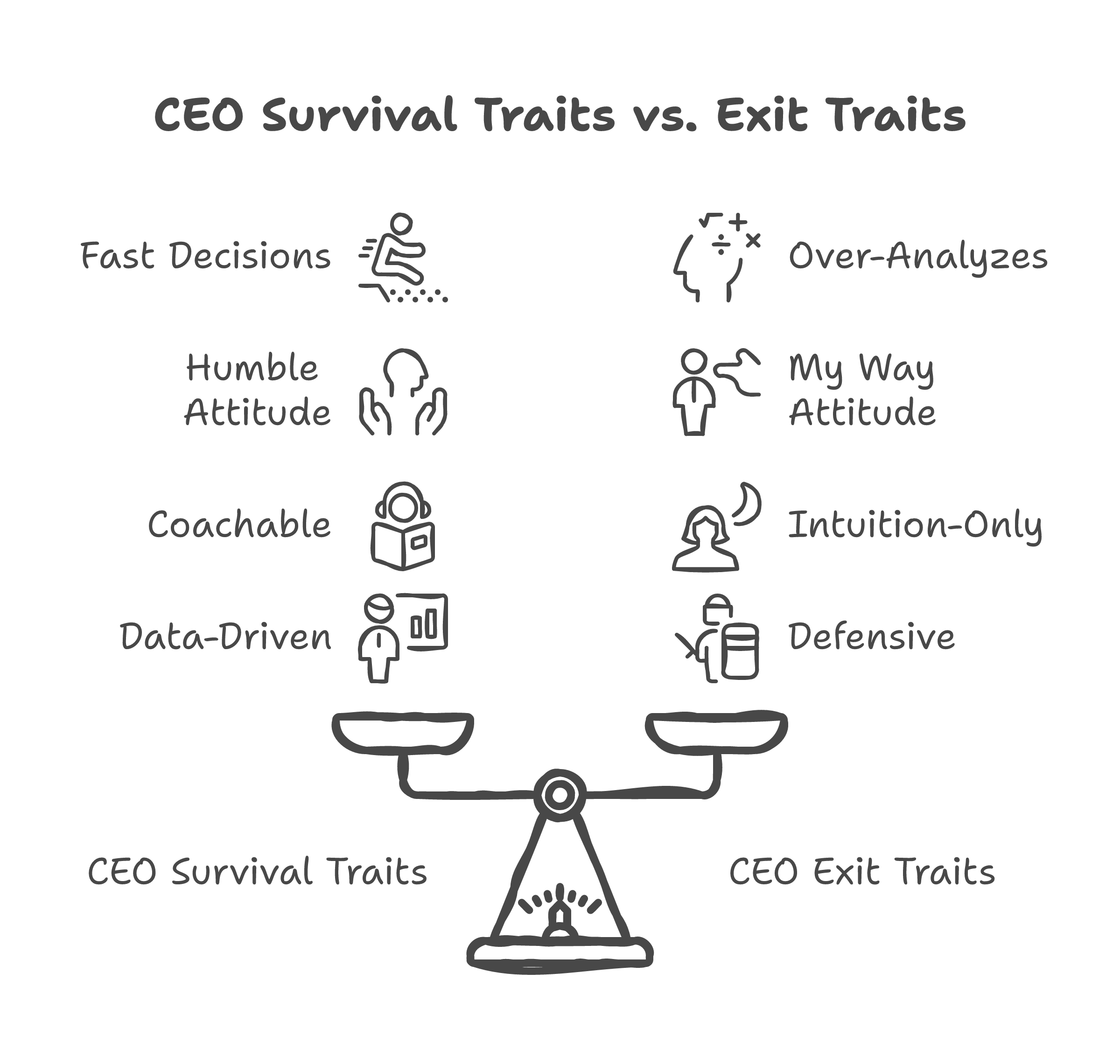
The 60% who make it past year two share common traits. None of them are about being brilliant. Most are about being adaptable.
Coachability Over Confidence
The operators who survive take feedback without defensiveness. When a board member suggests a different approach to forecasting, they try it instead of explaining why their way works better.
This is harder than it sounds. You built something. Your instincts were validated by success. Now someone with a spreadsheet is telling you to do it differently.
The coachable response is curiosity: “What have you seen work in similar situations?”
Data Fluency Over Data Volume
PE boards don’t want more reports. They want the right reports. The CEOs who thrive can answer “What are your three leading indicators?” without hesitation. They know which metrics predict problems before problems hit the P&L.
This isn’t about building dashboards. It’s about knowing what drives the business and being able to show it.
The operator who says “I think we’re doing well” loses credibility. The one who says “Pipeline velocity dropped 15% this month, which historically predicts a Q2 shortfall—here’s what we’re doing about it” builds it.
Speed Over Perfection
PE operates on compressed timelines. The CEO who needs three months to evaluate options while competitors move will frustrate their board.
This doesn’t mean recklessness. It means knowing the difference between decisions that need analysis and decisions that need action.
Humility Over Ego
The 40% who don’t make it often share a common refrain: “They don’t understand this business like I do.”
Maybe true. But irrelevant.
The ones who make it ask for help before they’re struggling. They treat PE partners as resources rather than obstacles. The goal isn’t winning every argument—it’s winning the outcome.
The First 18 Months: What Separates Success from Exit
If that 40% number has your attention, here’s how to stay in the other 60%.
Build reporting that shows you know your business. Not vanity metrics. The three to five numbers that predict success. If you can’t articulate what those are, that’s your first project. (The reporting drag calculator puts a number on what the current process costs.)
Ask for help before you need rescue. The worst time to tell your board you’re struggling is when you’re already behind. The best time is when you see a problem forming and want input on the solution.
Demonstrate learning, not just knowing. The market changed. Competition evolved. The CEO who says “we’ve always done it this way” signals inflexibility. The one who says “we learned X and adjusted to Y” signals adaptability.
Be ahead of problems, not behind them. When something’s going wrong, bring it up before the board asks. Come with the diagnosis and a proposed treatment plan. Surprises erode trust faster than problems do.
The Mindset Shift: Proving Future Value, Not Past Worth
Here’s the uncomfortable truth most day-one CEOs resist: PE didn’t acquire you because you’re irreplaceable. They acquired the business.
If you can lead it to the next level, great. If you can’t—or won’t—they’ll find someone who can. This isn’t ruthless. It’s rational. Leadership transitions are expensive and disruptive. Nobody wants to make one. But the math matters more than sentiment.
The CEOs who internalize this early have an advantage. They stop trying to prove their past value and start demonstrating their future value. They stop defending how things were done and start showing how things will get done.
It’s a subtle shift. But it’s the difference between year two and a transition package.
Reading the Signals Your Board Won’t Say Directly
Boards rarely deliver a clear verdict until it’s already decided. But they send signals.
Warning signs:
- Questions about specific decisions you made months ago (they’re building a case)
- Suggestions to “bring in some outside perspective” on your function
- Less engagement in your strategic proposals
- More engagement with your direct reports
Positive signs:
- Forward-looking questions (“How do we scale this?”)
- Interest in your development, not just the company’s
- Support for your initiatives even when results are pending
- Direct, real-time feedback (they’re invested in your success)
If you’re seeing warning signs, the time to adjust was months ago. But it’s not too late to start demonstrating coachability, data fluency, and speed now.
The Real Question
Bob Morse’s statistic isn’t meant to discourage. It’s meant to clarify.
40% don’t make it. That means 60% do. The difference isn’t luck or politics. It’s adaptation.
So here’s the question worth sitting with: If your board had to bet on whether you’ll be here in two years, how would they bet?
Not what they’d say. How they’d bet.
If you’re honest about the answer, you’ll know what to work on.
Alex Escoriaza helps PE-backed operators build the visibility and data fluency that keeps them in the 60%. If you’re navigating the transition, let’s talk.